

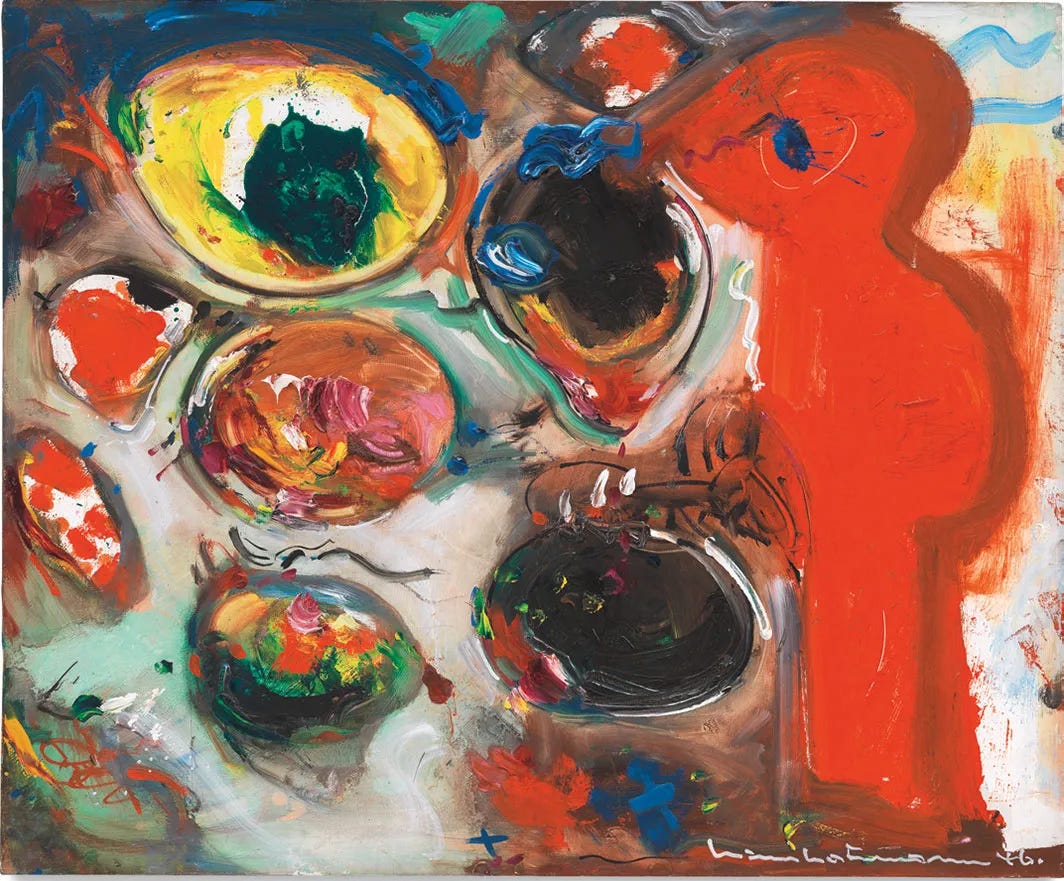
Hans Hofmann, The Conjurer (Small Version), 1946
So much of loving someone is entrusting them with your messiest emotions. You’re surprised when I pout like a child despite knowing that it’s unnecessary, embarrassing. But when I’m happiest I don’t suppress my range. The older I get, the more I feel capable of honoring the social contract as I understand it—of being gracious, polite, understanding, communicative, direct with a variety of different people in a variety of different situations. All of it feels so different from sinking into someone and knowing that you’re held.
The opposite of that feeling, of course, is placing your weight on someone and feeling like you’re sitting on a rickety stool that’s about to collapse. I’ve done that: it’s not a good sensation. The truth is that the fault was mine. I don’t know if I evangelize radical responsibility as a way of life, but understanding my own faults in judgment has certainly helped me work through many things. People are very complicated; they have mostly good intentions; we have to, as Leonard Cohen wrote, “let them off the hook, help them off the hook. Recognize the hook.”
In most relationships, I believe we are happiest when we love someone exactly as they are, tell them honestly when we think they should do something differently, acknowledge to ourselves the ways they do and don’t meet certain needs, and enjoy the joy, pleasure, and recognition we feel in their presence. Different people will be able to meet us to different extents, which is what I see as one of the fundamental rewards of friendship: we can love people, support them where they are and be supported where we are, without asking them to bear our entire weight. In this way, my friends have totally transformed my life, and transform it still. I’ve noticed that people are significantly more likely to work through major life problems when they have even one or two people they can tell everything to, who care about them and give them sage counsel. Just being witnessed and cared for is enough. Being truly close to one person can change your life more than you think.
Partnership is different, because it involves taking on someone else’s problems as your own. Of course, other people are separate from us, and it is very bad to take on total responsibility for a capable adult human being; we are each responsible for our own psyche, our own life. And yet if you are in a romantic relationship with someone you start to find that the way they think and feel naturally bleeds into how you think and feel; the way they express and receive love becomes entwined with how you express and receive love. When you have fundamental disagreements about how you approach things, the differences can become very painful.
On a recent trip to the Alps my friend pointed out that she thinks I have a very moral way of viewing relationships, in the sense that I believe there’s a way people should act. I’d never thought so, but when she said it I realized that I am obsessed with best practices. To be clear, I don’t always successfully implement those best practices, but all my writing is fundamentally about what you should do when you love and are loved, how to parse the various complexities that follow. Hearing her say this made me understand how a previous relationship failed simply because we were so far from seeing eye to eye on best practices that I lost faith in the enterprise. Our differences alienated me. Alienation, of course, is the opposite of intimacy. To me, the possibility of partnership is the feeling that despite the fundamental chasm between two human beings, love allows us to bridge the gap; alienation is the feeling that the gap cannot be bridged, and moreover, that I do not want to.
Best practices in relationships, of course, are both objective and subjective. Other people have different values, and different needs. It is not for me to judge their values, their needs, or the way they go about fulfilling them. It is up to me to honor my own, and if I care about them, find a way to support them in theirs. Supporting other people’s freedom is sometimes painful, sometimes humbling, sometimes liberating. More and more I try to save my philosophizing for writing, and my generosity for life.
It is hard to bridge the gap. We spend so much of our lives trying to figure out attachment, dependence, freedom, trust, acceptance, rejection, and commitment. I see people in happy partnerships try to figure it out with their friends; I see people circle around it again and again with their romantic partners; I see people get it right, get it wrong, get it right again. I don’t always have the language for what my heart knows. The living heat of your body is the living heat of your body, responsive, yielding, speaking to me without words. The love I feel now is the shock of realizing anew what I’ve already known for a long time. The same old Jack Gilbert poem all over again: What we feel most has / no name but amber, archers, cinnamon, horses and birds.
Thank you for reminding me what poetry is. And why I need it. And how words miss the mark and in the missing, they mark the solitude and community of my soul experience.
Thanks for sharing. I completely agree with your writing here and you articulate well the connection & distinction between friendship and partnership as well as the recognition that a certain kind of dependence is okay & even necessary in a romantic relationship.