

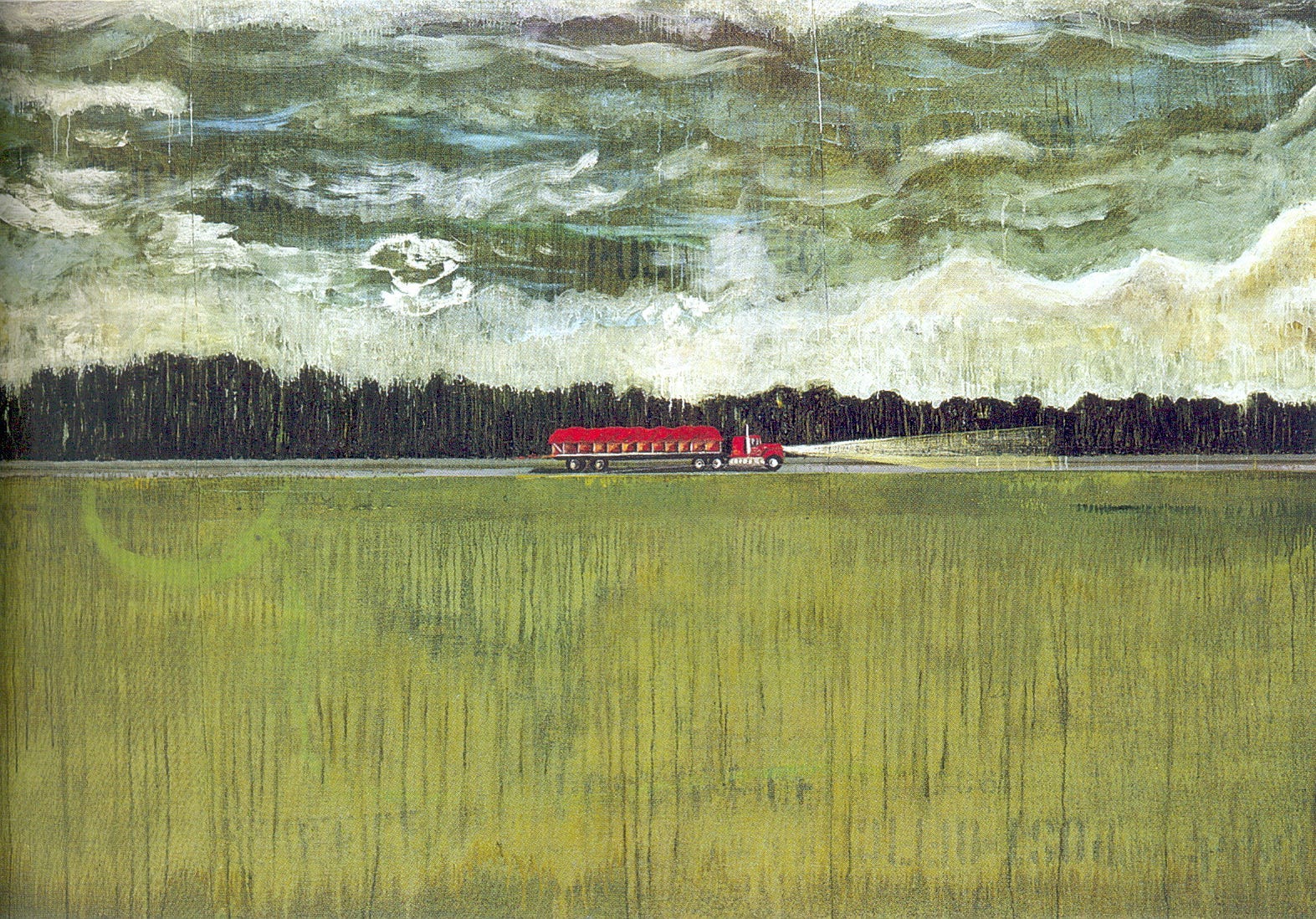
Peter Doig, Hitch Hiker, 1990
ANNOUNCEMENT: We are a hosting a Love Science x Bookbear Express matchmaking party on May 15th!! Take the quiz here and get your spirit animal. It’s gonna be very very fun.

The thing I like about desire is that it’s unfakeable. You cannot force or even simulate well intensely wanting someone or something. The very act of forcing by definition shuts it down. There is so much in life that can be attained simply through diligently going through the motions; desire is not one of those things.
I don’t like to fake things. I will not pretend to like you if I don’t; I won’t pretend to understand something I'm clueless about; when I stop having a good time, I leave. If I disagree with you and I care about you, I’ll tell you. Maybe this is not the best way for everyone to be, but there are a lot of people in this world who are willing to fake everything—I think they compensate for my bluntness. Also, I spent most of my life faking things, so I’ve paid my dues.
Visa: “I never fully realized how much pressure I was under, as a kid, to pretend I was fine when I was not. I pretended inwardly as well as outwardly. because I internalized “It’s not okay to be visibly not okay” from my social environment. So I became invisible to myself.” He goes onto say that writing is his “reaction against internalized tyranny.” It’s mine, as well. Before I started writing every day, I simply couldn’t make contact with my real feelings.
Accepting what you really feel is inconvenient, especially if you’ve built an entire life on the feelings you believe you’re supposed to have. There are extreme costs to integrating. I think about this Murakami line literally every day: “You don’t have to judge the whole world by your own standards. Not everybody is like you, you know.” Right: people are different from me, they feel different things, value different things, have different fears.
I know that the heart of love is acceptance. And yet I’ve spent so much time and energy trying to help people reconcile their conflict. All of it on some level is an escape from the fact that I value enormously a certain purity of feeling and the complete integration of it into my life. For me, desire has never been a part-time project. When I accepted that everything became easier.
Knowing who you are necessarily means tolerating that other people are different. Perhaps that’s why desire is conditional and love is not—love is about accepting the essence of someone, being moved by them; desire is more tied to a way of being. I guess what I’m saying is that I’ve learned I shouldn’t try too hard to convert people to a different way of being (unless they’re paying me, in which case… fine). That’s putting too much of the onus on me and not enough on them.
To me, desire is aliveness. It’s automatic, uncontrollable and rare. The body doesn’t often line up with the soul. In the novel I’m working on a character complains to her friend about the difficulty of finding true love when you can’t prove definitively that it exists. Her friend replies that it probably exists, but that doesn’t mean you’ll find it. (And of course, finding it doesn’t mean you’ll keep it.) I feel the same way about desire: there are no guarantees about finding it, no guarantees about losing it. I try my best to just live it.