

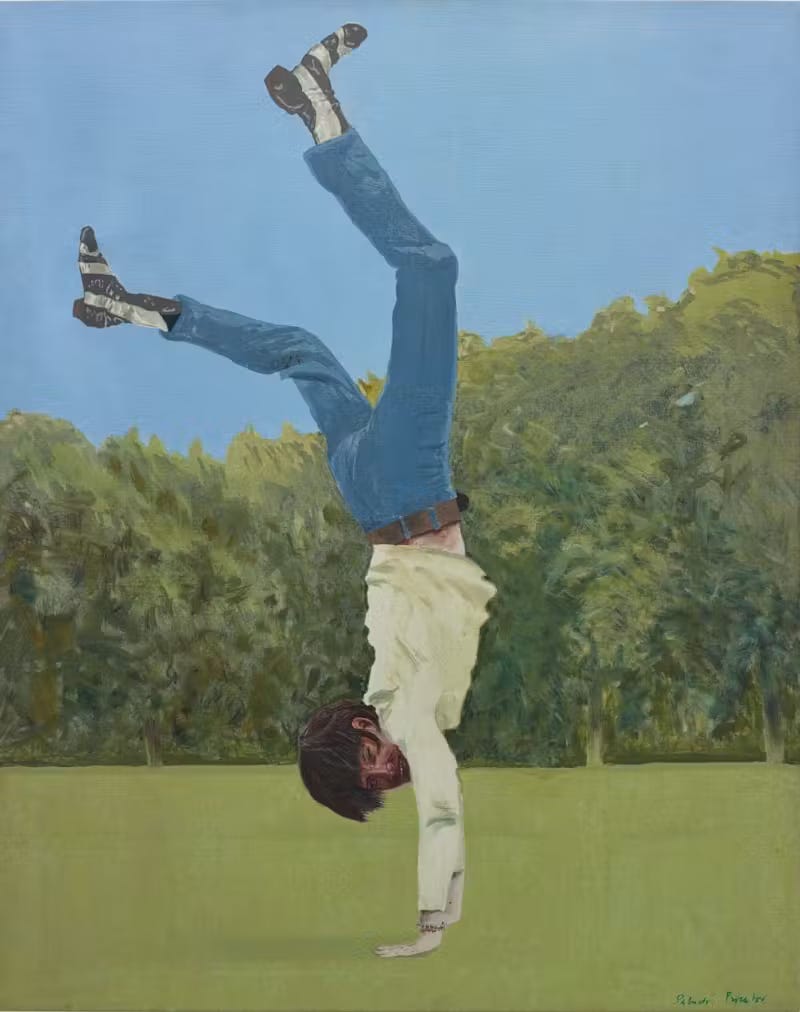
Patrick Procktor, Gervase IV, acrylic on canvas
I was at dinner with a longtime friend today and he casually brought up something I’d said to him a few years ago. I’d completely forgotten making the remark, and my immediate reaction was, Why would anyone say that? What I said was honest—way too honest.
I think I’m generally tactful, but in certain moments I can be brutally direct. My directness irritates me. It reflects an inability to fake it that causes problems. I’ve been having conflict this week with another longtime friend. I’m mad at him and he can tell. He said, “I don’t think you like me very much right now.” And I thought: how is it that I cannot muster the basic motivation to pretend that I am okay with things as they stand, when it would make my life easier? But I just can’t.
I don’t think this is a virtue. In fact, it’s almost certainly a vice. I understand that the gears of civilization are oiled by the ability to fake it. And to be clear, I can smile and nod along to a conversation I’m not enjoying with best of them. But the more invested I am, the less I seem to be able to pretend. And the longer I stay in my particular line of work, the worse it gets.
If I love you, I will not be oblique with you. I will be direct, and if you are oblique with me, I’ll press the question until you are direct. Sometimes this means that I get answers I don’t like. I’m pretty much resigned to that. It’s taken me a long, long time to learn this:

I believe there is extreme value in being in touch with your deepest emotions. They can tell you very important things about how you should live your life. I’ve also learned that you are the only person who is responsible for figuring out what they are. Do not think that you can go with the flow and someone else will anticipate your sincerest needs and desires for you. That is a great strategy for not getting what you want.
I think my relationship strategy is something like this: you should sincerely express your deepest desires, learn about the other person’s, and see if the most important parts of yourselves say yes to each other.
The problem is of course that we are forced to take other people at face value, and they may be varying degrees of in touch with themselves. Sometimes people are not quite what they present themselves to be, and that’s not because they mean to be disingenuous. I try my best to figure out if what I observe about someone else lines up with their self-narration.
As I become more self-aware I become a better narrator of my own desires. More and more my goal is to become someone who is so sincere I compel sincerity in others. I am working on sounding less like someone just shoved Veritaserum down my throat, but I think my directness reflects an impulse I find endearing: the desire for there to be fewer barriers between me and the people I love.
It’s definitely an interesting dilemma: certainly no one believes that you have to disclose every thought to the people closest to you. But I also believe that most of us disclose too few. That’s why I use the term “deepest emotions”—it’s fine to omit small things, maybe even medium size things, but I think there’s nothing more corrosive to a relationship than omitting core parts of your experience. You can tactfully pretend the elephant isn’t there, but the elephant is still going to step on you.
I do wish all the time that I could fake it. Why can’t I just ignore the stupid elephant? Everyone else is doing such a great job at ignoring it and I don’t want to disturb the party. It would be so nice and so easy to hang out right up until the moment I get smushed. (Is it even so bad to be smushed?) However I’ve reluctantly decided that each person is allowed to have their own threshold, and I don’t need to defend mine: I can just live it. It doesn’t make me feel virtuous, but it makes me feel like myself.
I like directness too! With friends and partners, I want to know each other, including negative feelings we might have about each other. I want our inner worlds to make direct contact.
This reminds me of Foreverland by Heather Havrilesky where one time she was comforting her husband, and her husband said he felt so close, and she told him she didn’t feel close in that moment. Of course he was upset, but she liked it for the long-term closeness of the relationship.
Honesty is high-risk, high-reward intimacy. I think it’s the highest form of intimacy. You can truly know each other and want to be there for each other, or you can find out your inner worlds are not compatible.
Direct but not rude, honest but not cruel, loving but not crude.