

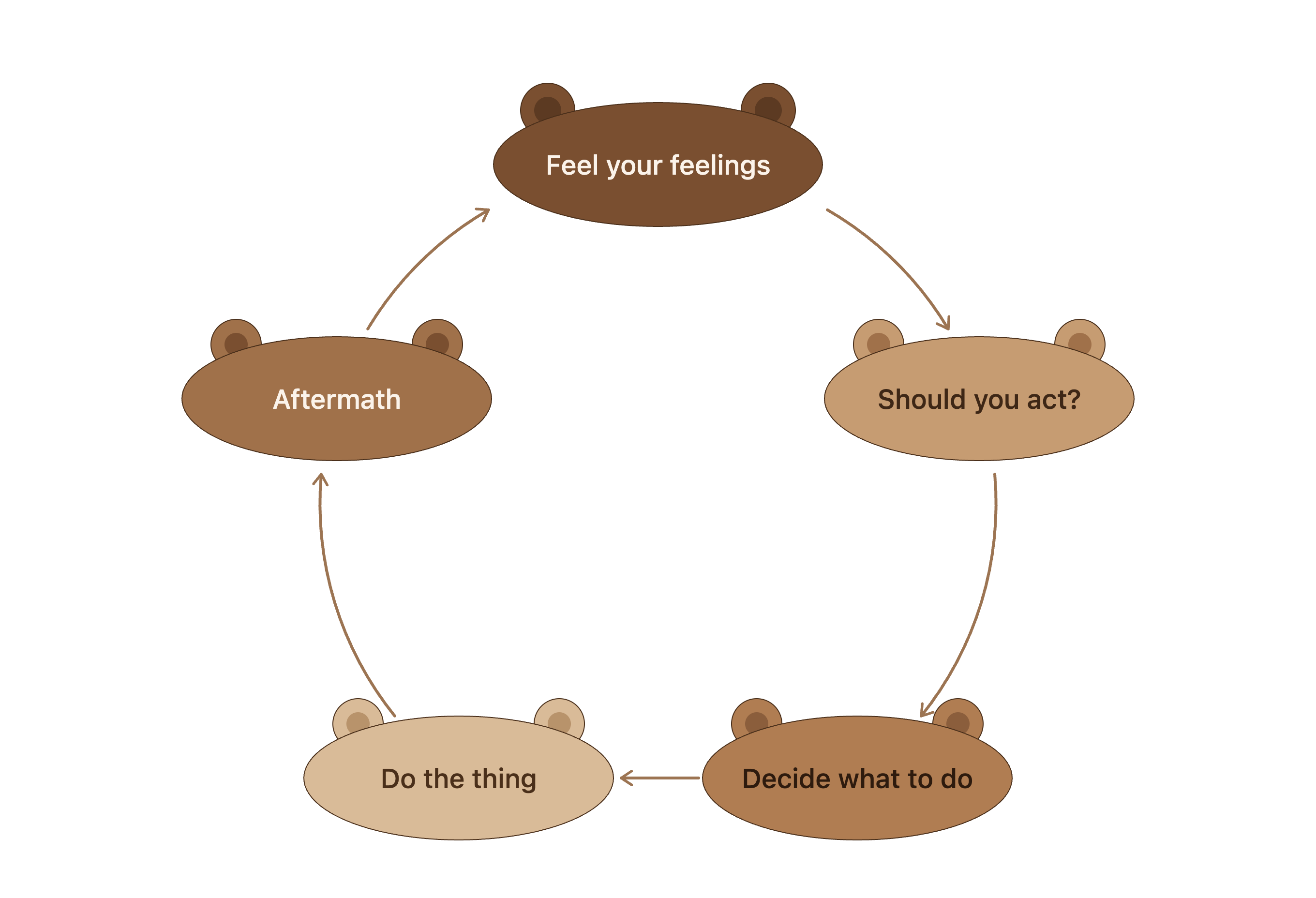
1. Feel your feelings
Things that can help with this: Focusing (in the Gendlin sense), meditation, yoga, psilocybin, journaling, simply sitting there and noticing what’s going on with your body (these are all variants of the same thing). It is best to do this when you’re not in a state of acute crisis. (Specifically please, please don’t do any drugs if you’re at all in an unstable state.)
Common failure modes: You are probably not conscious of all the things that you do to distract yourself from your discomfort. Common coping mechanisms: working, scrolling/browsing, alcohol/any other kind of substance, fixating on another human being, daydreaming/fantasizing.
Why do I need to feel my feelings? To put it simply, economy of movement.
Most people waste their whole lives going in circles. They act out the same relationship dynamic again and again. They quit their job, and choose another job that makes them unhappy. Almost always, they blame it on circumstances.
It is rarely, if ever, purely circumstance. Some of the most high-functioning, emotionally astute people I know act out the same dynamics again and again, and complain about being unhappy. “Smart people get themselves into all sorts of crazy situations because they’re really good at rationalizing things to themselves.”
In general, feeling your problems goes so much further than thinking about your problems. Thinking is mostly useful for strategy, and doesn’t get you very far when you’re not in touch with your emotional state.

Being “in touch” with your emotions (as in, your truest, deepest desires), is not intuitive to most of us, especially those of us who live much more in the analytical, cerebral realm. It’s normal to not know how to do it, and I recommend finding a qualified professional if at all possible, ideally someone you’ve seen produce good results in someone you think highly of.
2. Figure out if you should act on your feelings
Often the answer is “no.” Again, economy of movement.
Sometimes, the answer is yes. Let’s say you are trying to get from Point A to Point B in your life. Ask yourself: is this likely to just happen on its own?
Common failure modes: wishful thinking. “It’s all going to work itself out” is true in the sense of, if you do nothing, something happens. It’s just that the something may not be the thing you want, and in fact it might be the opposite of the thing you want. In my opinion, God loves strivers, so I personally recommend Making a Serious Effort to Get What You Want.
It can be easy to cosplay making a serious effort. For instance, say you want to meet a life partner, and then you go on a series of lackluster Hinge dates, decide that there’s no one out there for you, and call it a day.
Something I often ask clients is… Is this truly your best effort? Scratch that, is this even 75% of your best effort? If someone is ostensibly trying to “do something” and I can tell like they’re just cosplaying I honestly will not even talk to them about it because I feel like it’s a waste of my brain cells.
3. Decide what you should actually do.
At this stage I recommend talking to three to five people whose judgment you really respect. IT IS IMPORTANT THAT THEY KNOW YOU REALLY WELL. Ideally they’re all wired quite differently. For instance, when I’m trying to figure out what to do I generally talk to my therapist, who is a hippy-ish “feel your feelings” type, an -brained male friend, and an emotionally astute female friend, in addition to S, who is just very calm and smart. This way I get the full spread of insight. Sometimes the advice really diverges but generally I’m always surprised by how consistently people arrive at the same conclusions.
Of course, what I want to do matters the most, but I’m often too close to the problem to have the best perspective. Other people can check our blind spots for us, and offer general feedback on whether we’re delusional or not.
Friends who will tell you if you’re being delusional are worth their weight in gold. I should honestly make a whole Substack post about how to identify people who are good candidates for this.
Common failure modes: I’ve noticed over time that the excuses people give for not doing things sound logical at face value, but don’t hold up when you closely examine them. I can’t date because of [plausible-sounding excuse]. I can’t quit my job because of [plausible-sounding excuse]. But then when you really think about it, you might wonder… is that true, or is it an excuse mostly manufactured from thin air because they’re nervous about doing something and want to avoid it? Anyway, when I encounter an excuse from a close friend that seems entirely too convenient, I simply say, I’m not sure that makes sense, and then leave it there. And of course then I have to turn it back on myself…