

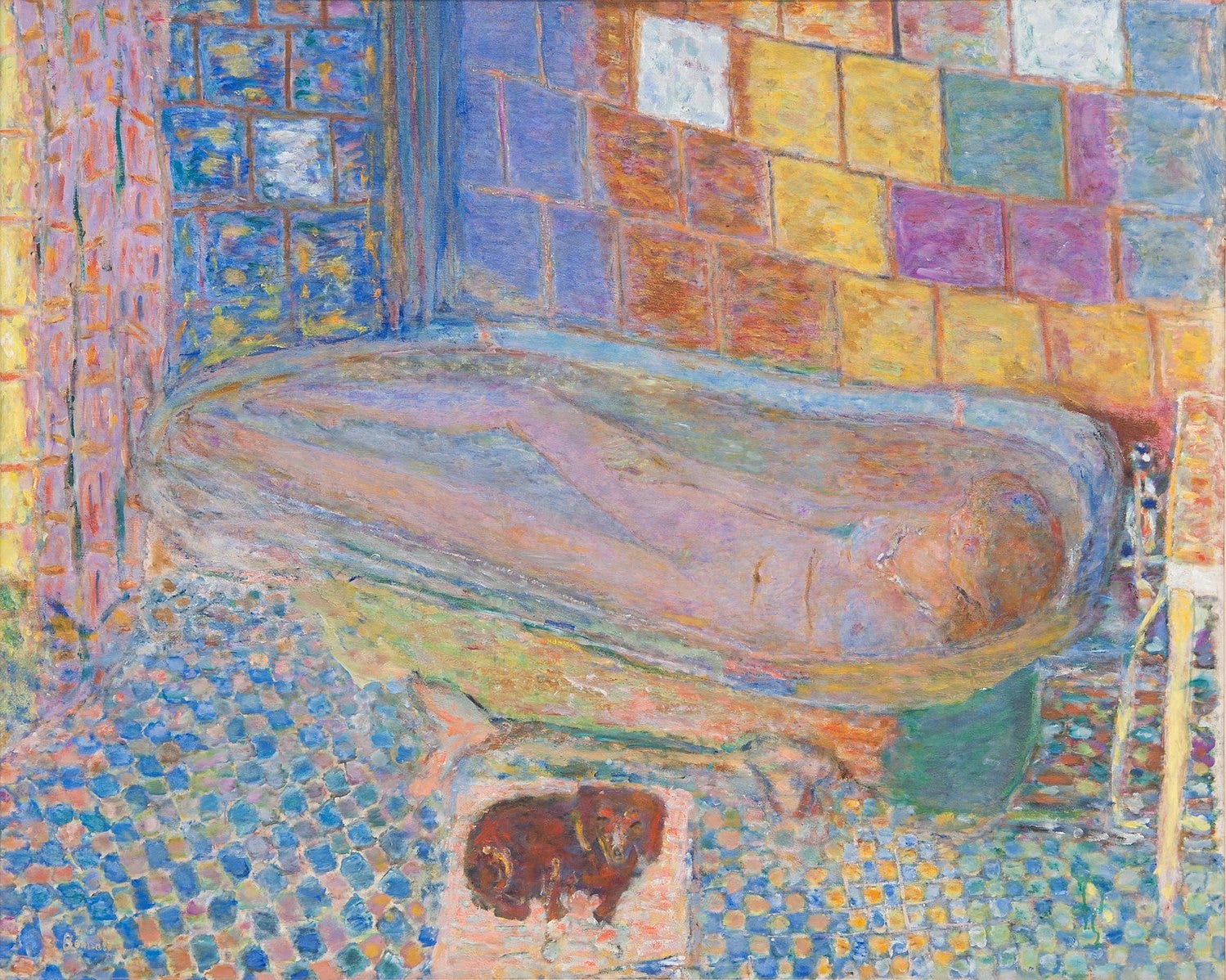
Pierre Bonnard, Nude in Bathtub
Hello! If you’re new here you can find the previous posts in this friendship series here:
Radical fun - on the friendship theory of everything
All of these posts are available to paid subscribers. Thank you for supporting my work!
I would greatly appreciate you filling out the Bookbear Express friendship survey if you have not already!

i. What’s the difference?
What’s the difference between friendship and romance? As far as I’m concerned, not much. Personally, I believe that close friendships are inherently romantic because they are inherently intimate. (The same may not apply to your gym buddy.) If you’re spending extended amounts of time together, sharing your deepest feelings, and having a lot of fun together, there’s inherently a level of intensity and depth there that’s somewhat romantic.
So, what is the difference?
Here’s how I see it, coming from a non-polyamorous but friendship-centered perspective:
Friendship uses romantic circuitry—I do think people can pairbond with their friends
However, friendship typically does not involve sexual intimacy OR any kind of romantic exclusivity. It also tends to not involve the structural closeness present in romantic relationships (sleeping in the same bed, traveling together all the time, etc)
Successful friendships are ones in which both people are satisfied with that equilibrium, and so are their respective romantic partners
The last point, of course, can be tricky. Close friends of the opposite gender obviously can cause friction in relationships, but I’ve witnessed a few situations where two people were dating and one person was jealous of the other’s same-gender best friend (everyone involved was heterosexual). It can feel terrible when you feel jealous of your boyfriend’s girl best friend, but oddly even worse if they seem to prefer their best guy friend over you.
Friendship certainly can inspire envy, even when it’s not about sexual or romantic competition. I remember being in my late teens and early 20s and dating these guys who seemed to have their lives perfectly together. I felt like I was walking on eggshells around them, auditioning for the role of partner. I was envious of their friends who fit so easily into their lives, and experienced none of the insecurity and fraughtness I did. When you’re unsure of someone’s love, it’s hard not to envy the people who seem to take it for granted.
The Bookbear Express Friendship survey unsurprisingly suggests that the vast majority of you are comfortable with opposite gender friendships. I like to think that all of us True Blue Friendship Believers are comfortable with opposite gender platonic intimacy, but I also get that it’s controversial in our culture at large. I’ve had two or three (2.5, let’s say) close friends who totally cut me (and all their other female friends) off after getting into relationships where their partner was not comfortable with opposite gender friendships. It was, to be frank, totally devastating. I did not make any attempt to change their minds, though I did grumble to all our friends for a fair bit afterwards. I like to think that it’s better to live my values than to debate them.
ii. What if you want to date your friend, or your friend wants to date you?
Early friendship
I find this to be most common in early friendship. Sometimes you meet someone and there’s amazing chemistry, but the two of you disagree about the implications of the chemistry.
Here’s the thing: chemistry doesn’t mean compatibility. If someone passes the six hour conversation test and they’re also kinda cute, it can be natural to wonder if the two of you should date. But if they don’t feel the same way, there is usually a deeper reason that may not be visible to you. That’s why I like to say that the best way to get over a crush is to ask questions. They might simply have different physical preferences, or worry that your attachment style is not compatible with theirs, or something even more arbitrary. For instance, I have a lot of Enneagram 7 friends, but I am not interested in dating 7s. I find that we have very different relationships with pain.
I find the best strategy if you’re interested in a friend is to make a gentle move, and see if it’s reciprocated. If it isn’t, accept their preferences. A “gentle move” can be something as simple as sitting closer to them on the bench or couch and seeing if they lean in or subtly scooch away from you. It really can be that simple!
I struggle with rejecting people
If you struggle with rejecting people, you probably have a fear of conflict and bad boundaries. Don’t worry, this is the most common thing in the world. But I really suggest you try to get over it.
Don’t worry, the person you reject is going to be perfectly fine. They may be crying, screaming, throwing up, and telling you they need you, but they do not need you. They are going to be okay. I have been cried on, screamed at and thrown up on, and all of those people were perfectly fine and have great partners now. I have cried and screamed at people and here I am, perfectly intact. It’s really just not that dramatic.
People should date if they both want to date. That is the only reason to date. Do not let yourself feel guilty about anything else. Just say no politely and tell them you’d rather be friends (ONLY if you genuinely want to be friends!).
Late friendship
This is harder! If someone you know really well wants to date you, the reason they think it will work is probably grounded in a deeper truth. But that still doesn’t mean it’s the right thing for the two of you.
I do think people date, break up and successfully recover the friendship. But I also know that it’s common for it to affect the dynamic negatively for a significant period of time, similar to working with a friend. My general advice is to exercise caution.
One of my guy friends believes that finding a life partner is so valuable and important that you should be willing to risk any number of friendships to test whether the person is the right partner for you. I find this very romantic, but there are a couple of friends I actually regret dating, because they were really weird about it after the fact and I honestly would have rather kept the friendship.
In general, I see this as a “risk it for the biscuit” situation. The rewards are great, but the dangers are certainly present.
iii. In general, should we date our friends?
I deeply believe in a “friends first, friends after” model of romantic relationships. I think there is an unfortunate epidemic of people out there who are dating people who they would never be friends with.
I remain good friends with S, whom I was in a relationship with for nearly seven years. There are multiple reasons for this, but the most important might be that we had platonic chemistry in addition to romantic chemistry. Physical attraction aside, we can yap on the phone for an hour, watch TV, and hang out. We like gossiping together. We like each other.
In my late teens/early 20s, I dated people whom I fell in love with, but didn’t really… like. If I weren’t attracted to them, I could never imagine just sitting on a couch chatting and drinking wine. We had different communication styles, different interests, different friends. At the time, I would’ve never believed this was a problem—I liked my boyfriend, of course I liked my boyfriend. But the truth was, I probably didn’t like my boyfriend as much as his friends liked him. That’s the beautiful thing about friendship: someone who likes you so much they just want to spend hours of their life with you for no reason than the fact that they enjoy the pleasure of your company.
It’s only more recently that I’ve realized I want to be liked by my partner the way my friends like me. My therapist helped me realize that I had a pattern when it came to partners: I chose people who were wildly in love with me, but also made me feel bad about certain aspects of my personality. Why are you doing this, it makes me jealous, I think you’re attention-seeking, you stress me out, etc etc. I’d always internalized this as my own problem—I thought I was easy to like as a friend, and harder to like as a partner. But my therapist had a different take: she said, Maybe you just choose to date people who don’t like you as much as your friends do.