

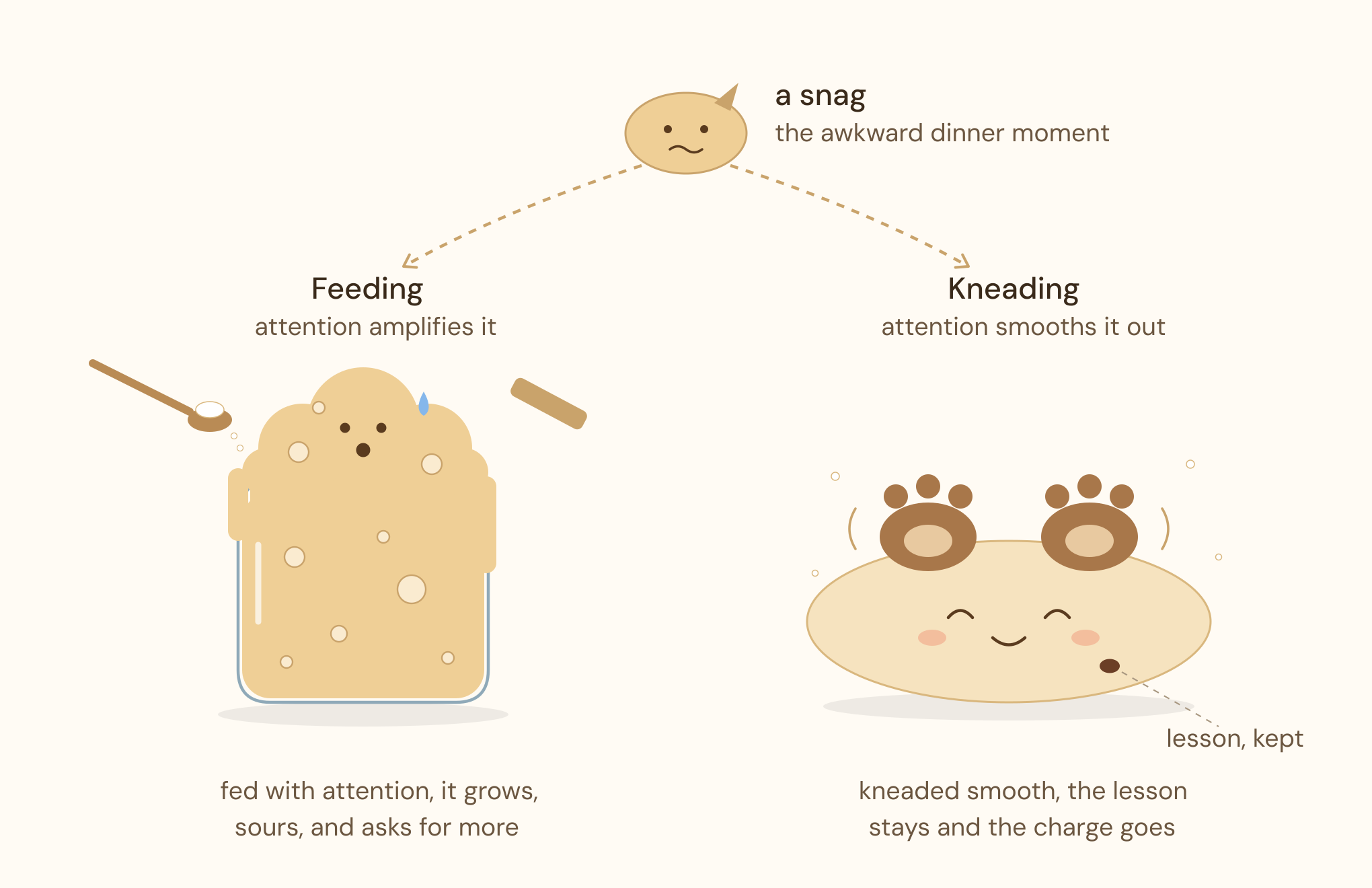
The world consists of a series of thorny surfaces our attention gets snagged on, and I’ve noticed where my attention falls changes radically depending on my state of mind. One concept I’ve been exploring in this vein is kneading versus feeding.
“Kneading” I visualize as kneading dough—noticing something, but instead of focusing on it and amplifying it with your attention, simply pressing and smoothing it out. (The dough, in this metaphor, is your mind/thoughts.) “Letting it go” is a similar concept, but tends to apply to bigger things—a failed relationship, for instance, or a tiff with a friend. I find kneading helpful in small moments—for instance, the other day I was at a group dinner with an acquaintance whom I perceive as consistently acting awkward around me. It’s been mildly confusing because I don’t actually believe this acquaintance has any reason to act awkward around me—as far as I know, we both quite like each other—and yet their behavior is Definitely weird. I find myself acting more strangely around them as a result, and then questioning myself after the fact as to whether I’m insane and made up the whole dynamic—is it all in my head? Anyway, that night at dinner I was in a mindspace where it was simple and intuitive to me that I should simply follow my own advice and Act Totally Normal. So I did! The moment passed. It wasn’t That Weird.
I think this is a good example because you can pretty easily imagine how Feeding the weirdness leads to a bad outcome—let’s say I consistently act strange around this person because I perceive them as acting strange around me. Before we know it, we’re both stuck in this dynamic that perhaps neither of us really wants. Visa said to focus on what you want to see more of. Unfortunately, most of us focus on what we’d actually like to see less of. We have a lot of extraneous thoughts and we mostly use our extraneous thoughts for evil.
Here’s how Michael Singer describes it, in a passage from The Untethered Soul I’ve thought about constantly since I first read it:
What it means to live life is to experience the moment that is passing through you, and then experience the next moment, and then the next. Many different experiences will come in and pass through you. It’s a phenomenal system when it is working properly. If you could live in that state, you would be a fully aware being. That is how an awakened being lives in the “now.” They are present, life is present, and the wholeness of life is passing through them. Imagine if you were so fully present during each experience of life that it was touching you to the depth of your being. Every moment would be a stimulating, moving experience because you would be completely open, and life would be flowing right through you.
But that’s not what happens inside most of us. Instead, it’s more like you’re driving down the street, here come the trees, here come the cars, and it’s all passing right through you with no trouble. Then, inevitably, something comes in that doesn’t make it through. There was this one car, a light blue Ford Mustang, that looked like your girlfriend’s car. But as it passed by, you noticed two people hugging in the front seat. At least it looked like they were hugging, and it sure looked like your girlfriend’s car. But it was a car just like all the other cars, wasn’t it? No. It wasn’t just like all the other cars to you.
Let’s look carefully at what happened. Surely for the camera of the eyes there’s no difference between that car and the others. There’s light bouncing off of objects, passing through your retina, and making a visual impression on your mind. So at the physical level, nothing different is going on. But at the mental level, the impression didn’t make it through. When the next moment comes, you no longer notice the rest of the trees. You’re not seeing the rest of the cars. Your heart and mind are fixated on that one car, even though it’s gone. You’ve got yourself a problem here. There’s a blockage, an event that got stuck. All the subsequent experiences are trying to pass through you, but something has happened inside that has left this past experience unfinished.
Most of us are constantly clinging to (“feeding”) thoughts and narratives that make us unhappy. In fact, the entirety of our identity may consist of those thoughts and narratives. We ruminate and obsess, and justify it by telling ourselves that it’s useful. Let’s take the topic of regret. We may regret how we acted in a particular situation. Let’s say we took Job A instead of Job B and Job B would’ve have yielded a vastly better outcome. There is a lesson in that, of course. However, for most of us, the lesson was probably sufficiently internalized many tens or hundreds of hours ago. But we are not satisfied with merely learning the lesson—we feel the intense compulsion to Feed the narrative itself. I was so stupid… my life would’ve been perfect if I had just done this… this is the fork in the road at which everything went wrong. Objectively, how does this benefit us? It doesn’t benefit us at all. In fact, it ruins our lives.
In order to avoid Feeding our negative thoughts, many of us turn to avoidance. But when you try to avoid touching the triggers that cause psychological pain, your whole life becomes defined by avoidance. I describe it as having landmines buried in your backyard. You know roughly where they’re buried, so you simply step around them. But as a result you end up heavily restricting your own movement. I can’t think about this with you. I can’t be around this person or I’ll feel bad. Your life becomes completely defined and restricted by the things that you can’t bear to be reminded of.
Another common tactic is suppression. Something happens, it makes you feel bad. So you think, There’s nothing I can do about that, and you push it down. You put on a TV show, or drink some wine, or scroll Twitter for many hours. It’s seemingly innocuous. Yet over time, you’re disassociating from yourself and blocking out what’s happening inside you. You think: things look fine in my life, especially from afar, so there must be no problem. But what happens is that gradually you lose touch with yourself. You’re coping without integrating—you’ve never solved the original problem, you’ve just buried it deeper and deeper.
The problem with things that you bury is that they 1) tend to involuntarily surface at some point, and 2) your whole life warps around them. We all know people like this—maybe we’ve experienced it ourselves. There’s something not right about something in your life—a relationship, a job, a breakup you’ve never processed—and it leads to you acting in ways you barely understand yourself. Some of the saddest moments of my life have been when someone tells me about something they did, and adds, seemingly baffled, “I don’t know why I did that. I knew it wasn’t the right thing to do, but I did it anyway.” Usually they’re looking for sympathy, but given my job, I’m generally not the best candidate.
I think the abiding principle of my work is that it is possible for us to know ourselves. Also: most people don’t want to know themselves. They would prefer to LARP self-knowledge: reflecting on what they’ve done wrong, ruminating about why they’re the way they are, imagining how they would act differently if they could. But you don’t need to deconstruct every piece of your childhood or revisit every wrong move you’ve made in every past relationship to know yourself. Most of that is just self-indulgence. Knowing, as I understand it, is just noticing and understanding: watching the thought flit across your mind, watching yourself engaging in a coping mechanism, watching yourself making a bad choice. And eventually: doing something differently.
Kneading is not suppression: it’s observing and integrating. You watch it happen, you feel it, and you absorb it. I think this observation about triggers is exactly right:


You will be triggered over and over until you learn how to stop reacting energetically. This week something happened to me which was pretty much an amalgamation of three medium-sized triggers for me. My first reaction was, Are you fucking serious. My second reaction was, I don’t want to expend mental energy on this. I had the distinct realization that I could get upset, think about how inconsiderate it was, and be annoyed, etc etc, but I didn’t actually want to feed it.
This has been a huge relationship unlock for me, in general: I try to simply not respond to the behavior I don’t like. (To be clear, I don’t mean this is an “ignoring the person” way.) It’s more like: life is so short, and I want to spend it focusing on what I want to see more of. And in general, that means that I don’t take it on myself to reprimand people.
For instance, a few months ago somebody in my life said something where I was just like… why would you say that? It wasn’t malicious, but it was deeply un-self-aware, and my rough understanding was that they perhaps said it in an attempt to make me feel insecure. And I thought: should I confront this person? Should I ask, Why would you say something like that? But I realized that I didn’t want to. I wanted to knead it, not feed it: I registered the remark, updated what I thought of the person, and decided that it was a sign I probably needed a different way of relating to them.
Relationships thrive when both people can be open and vulnerable. Sometimes you have to give instructions to someone so they can better love you. However, this is different from running a daycare. A big realization I had this year is that when I fixate on or feed behavior I don’t like, I am actually engaging in the equivalent of adult babysitting. Instead of doing that, I think it is more loving and respectful to tell someone what you feel clearly once, if you believe there might be any confusion, and then simply let things play out. The way that most people express anxiety is ineffective control—the classic example in codependency being someone who supervises their partner 24/7 to stop them from relapsing into alcoholism. It works, to some extent, but in a way you’re feeding a bad dynamic: you’ve made yourself part of a system that only works if you live in a way you don’t want to live. Your partner never develops the intrinsic motivation to change, because you function as a crutch. If we want to see someone’s real capacity to change, we often have to see what they do when they’re not dependent on us. Of course, this risks the knowledge that they don’t want to change at all.
In each of the examples I’ve listed, you can see that kneading involves keeping the information but dropping the fixation. Whether it’s a bad decision around a job or a friend being mean to us, we should probably update based on what we’ve experienced. But updating is different from obsessing, and many of us struggle to separate the former from the latter. It takes time, practice, and equanimity to be with what’s happening without struggling to control it.
When we can stay in the habit of kneading, we don’t experience the downsides of avoidance and suppression—we can stay in contact with ourselves and our lives—but we also don’t feed what we’d like to see less of. Another way I visualize it is surfing—we’re not avoiding the choppy water, we’re just working with it. When we approach the waves the right away, we can experience a lightness even in the midst of extreme turbulence.