

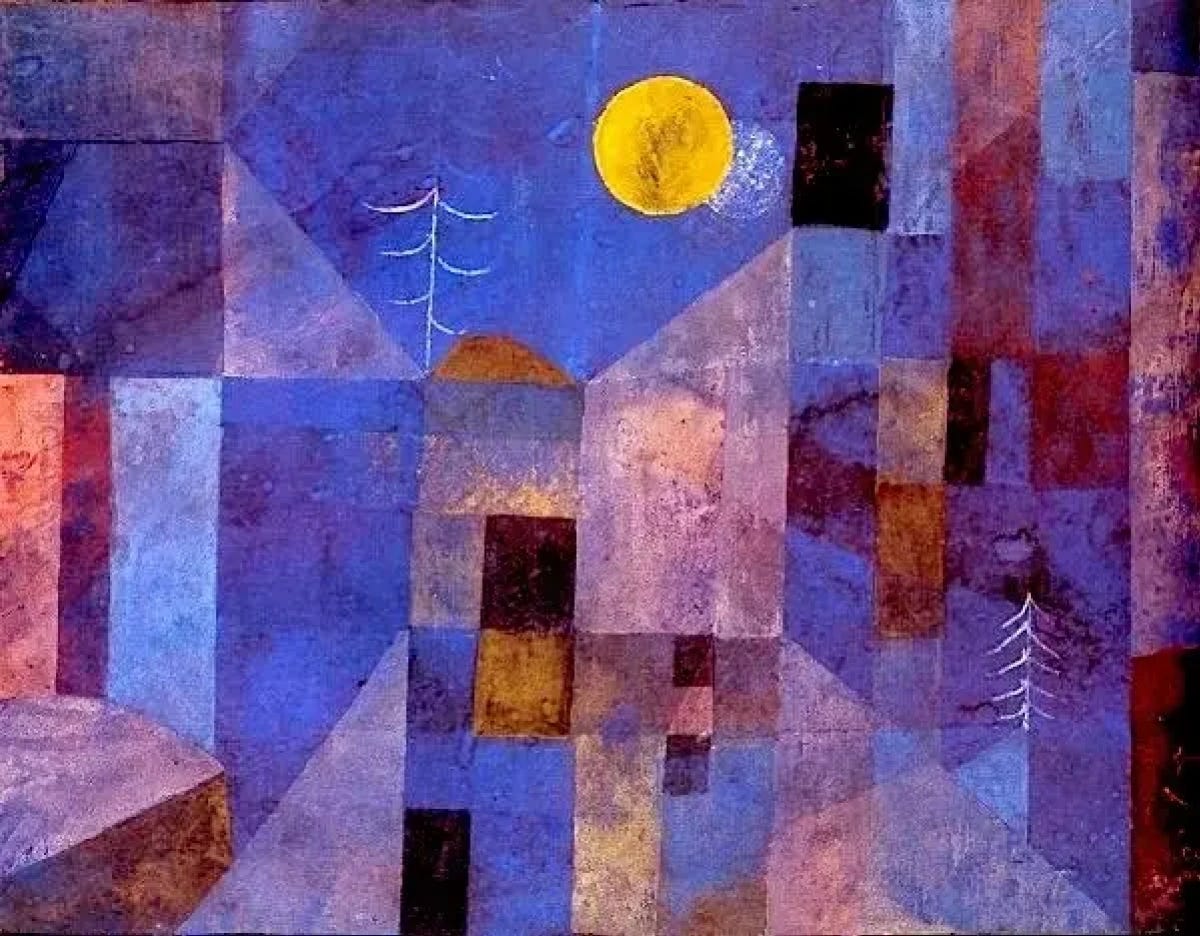
Paul Klee, Moonshine, 1919
If you’d asked me 10 years ago, I would have told you that I was one of the least likely candidates for becoming passionately moral. I’ve always been laissez faire, more drawn to utilitarianism than virtue ethics. It feels like a surprising and undeserved blessing to tumble into a set of beliefs and concerns that were never mine.
I also have always been a sporadically direct person. I can be very blunt, but by and large I preferred to be tactful and oblique. Over the past year, I’ve become more direct in ways that surprise me. I don’t find it difficult to say what I think.
Both of these changes feel like doorways. More of human experience seems open to me now, and I feel more solid, more myself. It’s strange to change in ways you didn’t intend to, then discover those changes are fulfilling and expansive. They feel necessary, though they happened by accident.
I’ve been thinking about this line that “most relationships are karmic, existing only to show you what parts of your anima/animus are not integrated.” It feels very true to me. What I find attractive in others is often directly correlated to what I’m missing in myself. And I think many of the ways I’ve changed have to do with correcting personal failings. Relationships show you how you fall short, and if you pay careful attention, you can change for the better.
There’s no formula for change, but here’s my best approximation: you have to be honest with yourself about what you avoid doing because it’s incredibly hard and painful. And then, over time and in increments, you try to do it. This is difficult. You are incentivized to mislead yourself about what the hard thing actually is. There is so much cognitive dissonance around it, and then so much emotional resistance.
But when you do change, and you observe yourself behaving differently, it feels so liberating. For so long I felt pinned in place, and now I know that things are different because I’m different. And I didn’t even want to change in these ways! It’s more like, I had a way of being that wasn’t working for me, or it was working but there were some issues with it, and I wanted to try something new, so I tried, and it didn’t work that well, so I tried again, and then eventually I had a new way of doing things.
No one likes looking too hard at their shortcomings. People seem to universally feel shame and berate themselves, but that’s so different from actually changing. You hate yourself so you trap yourself, and then it’s just more of the same. You live out of alignment, you wish you could do something differently, you keep living out of alignment. You ruminate, analyze, repeat the pattern. You know you’re repeating it, but you hope this time it’ll be different or better.
I lived like that for so long, just longing for something to change so I didn’t have to. Because change felt annihilatory, I couldn’t risk it or bear it. Then one day the door opened and I stumbled through it half-unwillingly and everything looked different. And I felt grateful for all of it, every sacred trigger.
For so long, my deepest knot was that I tried to help other people change as a way of resisting what I needed to do differently, let go of, grow. Of course I resisted—change is death. People fairly characterize most modern memoirs as always being about the narrator overcoming their dysfunctions and solving all their problems, right up until the next memoir. I don’t think I’ve solved all my problems, and I don’t at all know what’s to come. But I know my behavior has changed in ways I’m proud of, and I am more present with my discomfort.
When people tell me how they see me, it’s so much about them. The question I always struggled to answer was how I wanted to live, how I wanted to be. Change is just the byproduct of answering that question.
“The question I always struggled to answer was how I wanted to live, how I wanted to be. Change is just the byproduct of answering that question.”
This resonates deeply. Great article. 🩷