

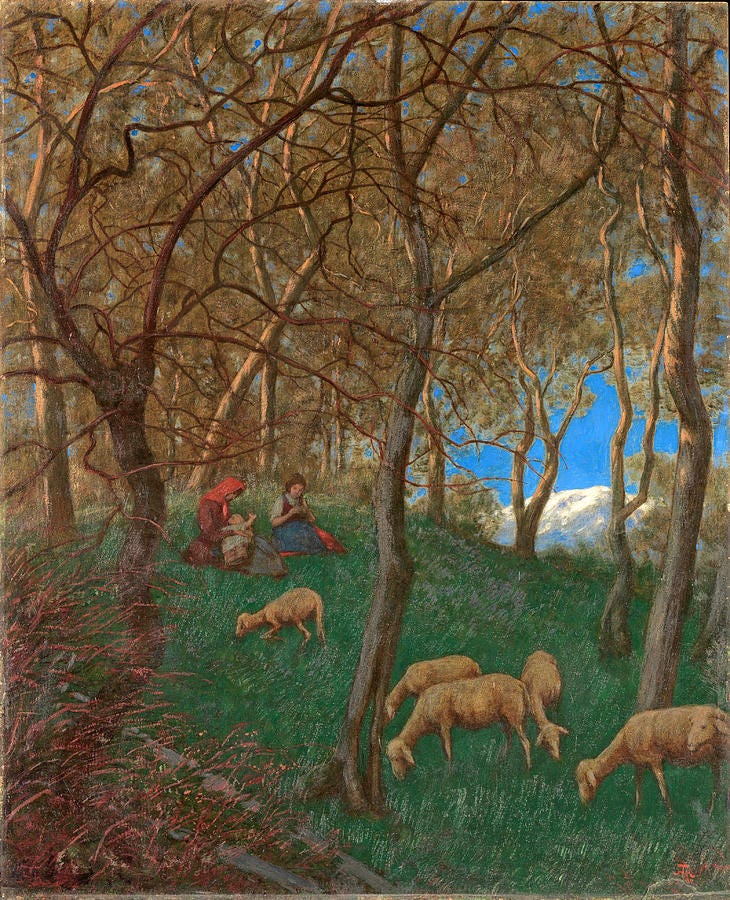
Hans Thoma, At Lake Garda, 1907
Housekeeping: I took a pause for a few months but I’m taking on new clients again! I enjoy helping people with dating, breakups, and decisions/transitions. My ideal is for us to work together for a bounded period of time (say, four sessions) to help you making progress on, accomplish or decide something. I do occasionally keep seeing clients past this period if we like working together!! (If you’ve filled out my previous form in the past couple of months, don’t worry, I’ll be emailing everyone who did). And I’ll get the broader matchmaking survey out in the next few days :)

My friend says that the couples she appreciates most are the irrational ones, people who not only have nothing to gain from each other, but in fact a great deal to lose. I feel the same way: there is no Didion line I relate to more than the one that goes “I came into adult life believing … that salvation lay in extreme and doomed commitments, promises made and somehow kept outside the range of normal social experience.” I like irrational pacts, I make irrational pacts, and one of the great learnings of adult life for me is that tradeoffs are inherent to these pacts, not anti-romance but in fact fundamentally romantic. For instance:
It is good, actually, that we can’t get everything from one person.
The worst way to relate to this is to bemoan it. The best way to relate to it is to understand that the fact that one person can’t have every quality in the world is an opportunity to examine what matters the most to you.
There is no uniform correct answer to this, and to be honest most people don’t know their answer. We all tend to long for people who are some combination of hot and smart and charming and kind and fun, and what happens over the course of life is we meet someone who possesses a specific combination of those qualities, and they yank at us in a way that’s unexpected. What we like is often not what we anticipate liking, and what we value the most is not necessarily what we fantasize about the most.
I had the realization recently that many of the behaviors that I believed were intrinsic to me in a romantic relationship were merely responses to the other person. I’ve also seen this happen to acquaintances, friends, and partners: you believe you’re a certain way, and it turns out that you aren’t. You think you’re restless or closed off or overly independent or anxious and then you meet someone and realize: that’s not who I am at all. That’s the way I behave in the presence of many people.
Someone once told me that they loved me for the way I made them feel. At the time, I was affronted, but I now have a more generous interpretation: they really liked being the person that they were in my presence. After all, the qualities someone possesses do not exist in a vacuum: ideally, we do not love someone because they’re objectively beautiful, but because they’re particularly beautiful to us. There is some kind of special gestalt created by their being when it’s in the presence of ours, and that gestalt is… better.
The problem that haunted me most of my adult life, as far as romance was concerned, was that I did not know how I wanted to feel in the presence of another person. All I knew to seek was validation, safety, and praise. In time, I’ve come to understand that I would trade almost anything to be known. Fully understood, not in the sense that someone can describe my behavior or tell me about the qualities I possess, but in the sense that how they behave towards me implies a deep understanding of my desires, values, and way of being. Because that, of course, is the expensive and unfakeable thing: behavior.
I’m always surprised by how many people choose partners who are incapable of knowing them in order to sidestep this whole issue. For many, safety feels like holding yourself at a respectful distance: it’s entirely possible to eat with, sleep with, and share the rhythms of life with a person you love greatly while shielding your interiority from them. This, too is a tradeoff.
We are not owed everything; we are not owed anything except common human decency, and we may fail to receive even that. From Eurydice’s post on wants vs needs (I have been binging her Substack recently, and suggest that you do too):
You don’t need esteem, sexual excitement, emotional connection, in order to survive, of course. You do in some sense have a need for them, as a member of the human race, in that life is considerably harder without them. The obligation to fulfill that need always lies with you, not with your spouse. Most people reach for “needs” instead of “wants” because they want to take advantage of the very non-negotiable quality of a need.
Being known is a want, not a need. Sometimes doing the work to be known by another human being feels like Great… now I have to creative direct my way into a tolerable relationship experience. (I hate when I'm on a flight and I wake up with a water bottle…) But that, too, is a tradeoff, because over time I have accepted that the optimal amount of creative directing is far from zero.
I, like everyone else, wish that someone could simply sense what I want. But unfortunately I do not tend to be compatible with the type of guy who is really into chakras, despite being pretty into chakras myself, and being into chakras is very useful for this kind of thing. So instead I’ve learned to use my words.
Using your words is really powerful. I recommend it. The best tradeoff I’ve ever made is accepting the embarrassment of articulating my insecurities and desires in great detail in return for the people I love giving me more of what I want. In this instance, humiliation is so worth it. I think this tweet is true:

Most people are uninterested in sincerely and straightforwardly stating what they perceive and what they want. This is because they intuitively understand that the other person may be uninterested in giving them what they want, and risking the truth feels Really Bad. But both things are true: other people are not slot machines you put effort into in order to receive love and acceptance, and also it is worth being sincere.
The tradeoffs we make tell us who we are. Sometimes it’s not very fun to realize who you are. I’ve been making tradeoffs all my life, because that’s what literally everyone does, but the truth is that I was never fulfilled until I started feeling like the tradeoffs I made were representative of who I actually was. It’s hard to conceive of yourself as generous if you don’t act generously. It’s hard to conceive of yourself as romantic if you don’t act romantically. Who you are today doesn’t have to be who you are tomorrow, but for many confronting who they are today is so hard that they’d rather live in perpetual denial.
Endemic to all of this, of course, is what it means to be on the other side: what do we do when someone makes the tradeoff that leads them away from being with us? And I know this is infinitely easier said than done, but it’s best to celebrate other people’s freedom. Desire, after all, arises when we notice someone else’s power and autonomy. In short, their ability to live without us is what makes the soft underbelly exposed by their choice to be with us meaningful.
One of the most satisfying feelings in the world is looking at your partner and realizing that a beautiful, vital, autonomous human being, different from every other person in this world in their specific habits, interests, personality, and memories, is the one person you have chosen, and they choose you back. Love at its best, to me, has always felt like the opposite of compulsion. They do not need you; you do not need them; there are infinite other tradeoffs you both could be making, and yet. You are here because you want to be here. You want nothing else as much as you want to be here. Duty is the practice of virtue; romance is the exercise of free will.