

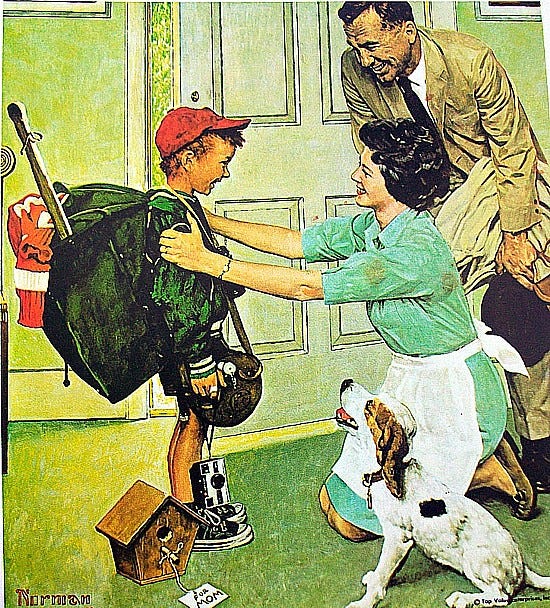
Home From Camp, 1976, Norman Rockwell
I am closing the matchmaking form tomorrow night!
I saw a Tiktok this morning that claimed “romantic relationships are the easiest relationships unless you are secretly treating your partner like your parent.” He goes on to explain that most people are out looking for a parent instead of a partner. It’s something that I’ve been part of on both sides, and something that I see people doing literally every day. I’ve been thinking about it in one or another since I read the books Mother Hunger and The Fantasy Bond.1 Both are books about how as adults we desperate try to replicate the love we wished for as kids. Kelly McDaniel: “The term Mother Hunger captures a compelling, insatiable yearning for love—the sort of love we dream about but can’t find. Many of us mistake Mother Hunger for a craving for romantic love. But in truth, we are longing for the love we didn’t receive during our formative moments, months, and years.”
In the past couple of years, I’ve really come to understand how when I thought I was looking for the experience of romantic love, I was actually looking for the experience of completion. As in: expecting another human being to provide the all-consuming, regulating love that a parent provides a child. My journey with this is pretty well summarized by these two tweets:


The problem with parenting your partner or expecting your partner to parent you is that you are two adult human beings in a voluntary romantic relationship, and neither of you in fact totally responsible for the other’s welfare. So if your assumption is that your partner will act like your parent, you’re in for a rude awakening, because at some point you’re going to realize: Oh my god. This person is not in fact acting like my mom. And this can feel like a huge letdown. Years ago I was in a version of this dynamic where for complicated reasons I had decided to take it upon myself to behave like my partner’s surrogate parent. You could say I was trying to provide the IPF (Ideal Parent Figure) protocol experience. This usually consists of five caregiving components: